We are excited to present the second edition of the PCCM Global Critical Care Article of the Month! Every 2 months, a team of pediatric intensive care experts from WFPICCS selects one outstanding paper from Pediatric Critical Care Medicine, the Official Journal of WFPICCS, to spotlight key advances, emerging evidence, and perspectives shaping our field.
This initiative aims to foster continuous learning and reflection, encouraging our global community to engage with the latest research that informs and improves the care of critically ill children worldwide.
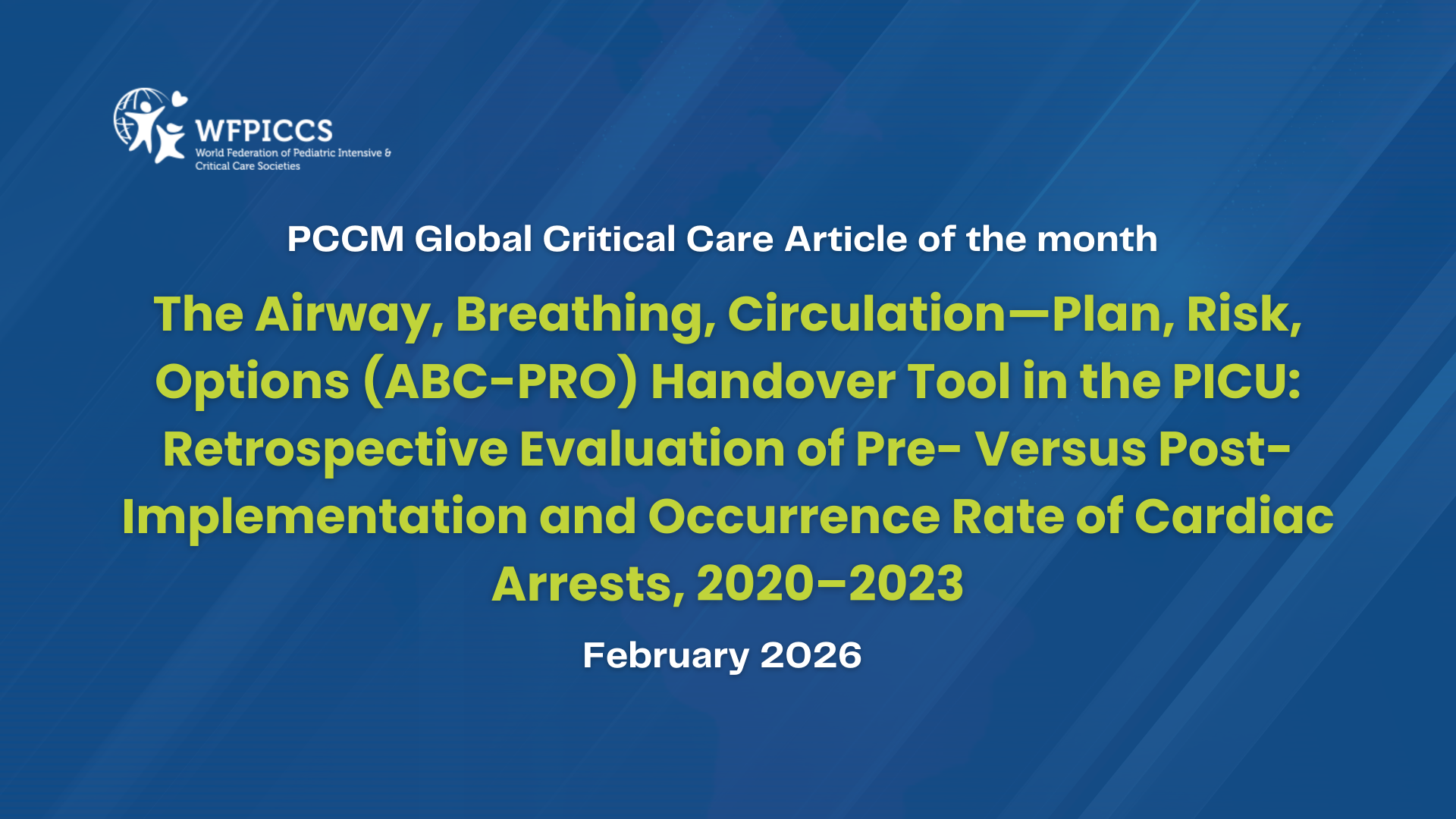
The selected Article for February 2026 is The Airway, Breathing, Circulation—Plan, Risk, Options (ABC-PRO) Handover Tool in the PICU: Retrospective Evaluation of Pre- Versus Post-Implementation and Occurrence Rate of Cardiac Arrests, 2020–2023
Expert commentary by Cintia Johnston
Why This Question Matters?
Preventing cardiac arrest in the pediatric intensive care unit (PICU) remains a critical goal in pediatric critical care. Although relatively uncommon, in-unit cardiac arrest is associated with significant mortality, prolonged ICU stays, and increased neurological morbidity. Large multicenter studies have reported survival to hospital discharge after PICU cardiopulmonary resuscitation of approximately 40–50%, emphasizing the profound clinical and resource impact of these events¹.
Cardiac arrests in the PICU are rarely sudden, unpredictable events. In many cases, physiologic deterioration occurs hours before arrest, providing an opportunity for early recognition and escalation of care². This observation has led to increasing interest in interventions that improve situational awareness, multidisciplinary communication, and anticipatory planning.
The study evaluating the Airway, Breathing, Circulation—Plan, Risk, Options (ABC-PRO) handover tool addresses precisely this gap. Rather than focusing on improving resuscitation performance after deterioration occurs, it targets a more upstream objective: preventing arrest through structured communication and proactive risk identification.
What Did This Study Add?
The authors evaluated the implementation of the ABC-PRO handover tool during PICU bedside handovers and multidisciplinary rounds. The tool structures communication around three forward-looking elements:
- Plan: the immediate clinical management strategy
- Risk: anticipated deterioration within the next 12 hours
- Options: predefined escalation strategies should deterioration occur
Following implementation, the adjusted cardiac arrest rate decreased from 2.9 to 1.2 events per 1,000 PICU days, corresponding to an adjusted rate ratio of 0.42 (95% CI 0.20–0.88). The reduction appeared particularly pronounced in cardiac surgical patients.
This finding aligns with previous quality improvement initiatives demonstrating that interventions aimed at improving team situational awareness—such as structured huddles or risk-stratification systems—can reduce cardiac arrest incidence in pediatric cardiac ICUs³,⁴.
Importantly, the ABC-PRO intervention is conceptually simple and operationally feasible. It does not require advanced monitoring systems, artificial intelligence tools, or complex analytics. Instead, it relies on structured interprofessional communication, which makes it a potentially scalable strategy across diverse PICU settings.
The Cost Story: Why This Matters Globally
One of the most compelling aspects of the ABC-PRO model is its minimal resource requirement.
Many contemporary safety initiatives in intensive care depend on sophisticated predictive analytics platforms or expensive monitoring technologies. While promising, these solutions may not be feasible in low- and middle-income healthcare environments.
In contrast, ABC-PRO represents a communication-based safety intervention. Its core components—structured bedside handover, shared risk language, and anticipatory planning—can be implemented without additional technological infrastructure.
This characteristic is particularly relevant from a global pediatric critical care perspective. Programs such as the Pediatric Cardiac Critical Care Consortium (PC4) have demonstrated that prevention bundles and situational awareness programs can significantly reduce cardiac arrest incidence in cardiac ICUs⁴. However, many PICUs worldwide operate outside such large collaborative networks.
A low-cost strategy such as ABC-PRO therefore has strong potential for global dissemination, particularly in settings where the burden of critical illness is high but technological resources are limited.
Interpreting the ICU Readmission Signal
The present study did not report PICU readmission rates, which limits the ability to fully interpret system-level effects of the intervention.
In theory, interventions that promote earlier escalation of care may reduce cardiac arrests but potentially increase ICU utilization or unplanned readmissions. ICU readmission has often been used as a quality indicator in pediatric critical care, although its interpretation remains complex⁵.
Readmissions may reflect premature ICU discharge or inadequate ward monitoring, but they may also represent an appropriately functioning rescue system that identifies clinical deterioration early. Without readmission data, it is difficult to determine
whether the observed reduction in cardiac arrest reflects improved anticipatory management or altered thresholds for escalation.
Future evaluations of ABC-PRO would benefit from including outcomes such as:
- ICU readmission
- emergency intubation outside the ICU
- rapid response team activation
- ward cardiac arrests
Such metrics would provide a more comprehensive picture of the intervention’s impact on the hospital safety ecosystem.
Variation Across Centers: Culture, Not Risk Alone
Another important consideration is the role of institutional culture.
Significant variation in pediatric cardiac arrest incidence across PICUs has been reported in multicenter studies, even after adjusting for patient characteristics⁴. These differences suggest that institutional processes, communication practices, and team culture play substantial roles in patient safety.
The ABC-PRO framework may function not merely as a checklist but as a cultural intervention. By requiring teams to explicitly discuss anticipated deterioration and escalation plans, it reinforces a shared mental model among physicians, nurses, and respiratory therapists.
Structured communication tools such as I-PASS have previously demonstrated significant reductions in medical errors and preventable adverse events in hospital settings⁶. ABC-PRO may represent a PICU-specific extension of the same principle: that reliable communication structures can enhance patient safety by improving team situational awareness.
Counterpoints and What This Study Does Not Tell Us
Despite its promising findings, several limitations must be considered.
First, this study uses a retrospective before-and-after design, which limits causal inference. Temporal changes in patient population, staffing, or other quality initiatives may have contributed to the observed reduction in cardiac arrests.
Second, although illness severity appeared similar between periods, the post-implementation cohort included fewer cardiac and cardiac surgical patients, which may have influenced baseline arrest risk.
Third, implementation fidelity was not measured. It remains unclear how consistently the ABC-PRO framework was used across handovers or which specific components contributed most strongly to the observed effect.
Fourth, the study was conducted in a single tertiary center, raising questions about generalizability. Successful implementation likely depended on local leadership engagement, staff buy-in, and institutional culture.
Finally, although overall PICU mortality decreased after implementation, postarrest mortality did not change significantly. Therefore, the study suggests reduced arrest incidence, but it does not demonstrate improved resuscitation outcomes
What Should Change in Practice?
Despite these limitations, the study provides valuable insight into the potential role of anticipatory communication in PICU safety.
Three practical implications emerge.
First, PICU handovers should move beyond descriptive clinical summaries toward forward-looking risk communication. Explicitly addressing what may deteriorate and how teams will respond may reduce delays in escalation.
Second, structured situational awareness strategies should focus particularly on high-risk patient populations, including cardiac surgical patients, infants, and patients with complex cardiopulmonary disease, who consistently demonstrate higher cardiac arrest rates²,⁴.
Third, centers adopting structured handover frameworks should pair implementation with prospective monitoring of safety outcomes, including cardiac arrest incidence, emergency escalation events, and ICU readmission.
Ultimately, the ABC-PRO model reinforces an essential principle of pediatric critical care: many cardiac arrests are preventable when teams share a clear, anticipatory understanding of risk.
References
- Berg RA, Nadkarni VM, Clark AE, et al. Incidence and outcomes of cardiopulmonary resuscitation in PICUs. Crit Care Med. 2016;44(4):798-808.
- Alten JA, Klugman D, Raymond TT, et al. Epidemiology and outcomes of cardiac arrest in pediatric cardiac ICUs. Pediatr Crit Care Med. 2017;18(10):935-943.
- Dewan M, Soberano B, Sosa T, et al. Assessment of a situation awareness intervention to reduce cardiac arrests in the PICU. Pediatr Crit Care Med. 2022;23(1):4-12.
- Alten J, Cooper DS, Klugman D, et al. Preventing cardiac arrest in pediatric cardiac intensive care units through multicenter collaboration. JAMA Pediatr. 2022;176(10):1027-1036.
- Odetola FO, Clark SJ, Freed GL, Bratton SL, Davis MM. A national survey of pediatric critical care medicine: practice patterns and ICU readmission. Pediatrics. 2007;120(4):e1003-e1011.
- Starmer AJ, Spector ND, Srivastava R, et al. Changes in medical errors after implementation of a handoff program. N Engl J Med. 2014;371(19):1803-1812.
- Sperotto F, Daverio M, Amigoni A, et al. Trends in pediatric in-hospital cardiac arrest outcomes: systematic review and meta-analysis. JAMA Netw Open. 2023;6(2):e2256178.
- Jones IGR, Friedman S, Vu M, et al. Improving daily patient goal setting and communication in the PICU. Pediatr Crit Care Med. 2023;24(5):382-390.
- Parikh NR, Francisco LS, Balikai SC, et al. Improving interfacility communication using structured electronic PICU handoff tools. Jt Comm J Qual Patient Saf. 2024;50(5):338-347.
- Spaeder MC, Lee L, Miller C, et al. Impact of predictive analytics displays on cardiac arrest incidence in the PICU. Resusc Plus. 2025;21:100862.
You can read the full Article here: https://journals.lww.com/pccmjournal/fulltext/2026/02000/the_airway,_breathing,_circulation_plan,_risk,.8.aspx